In our previous article, we established that compliance and prequalification are foundational steps that produce significant improvements in safety performance in areas such as serious injury, illnesses, work disruptions, and most importantly, fatalities.
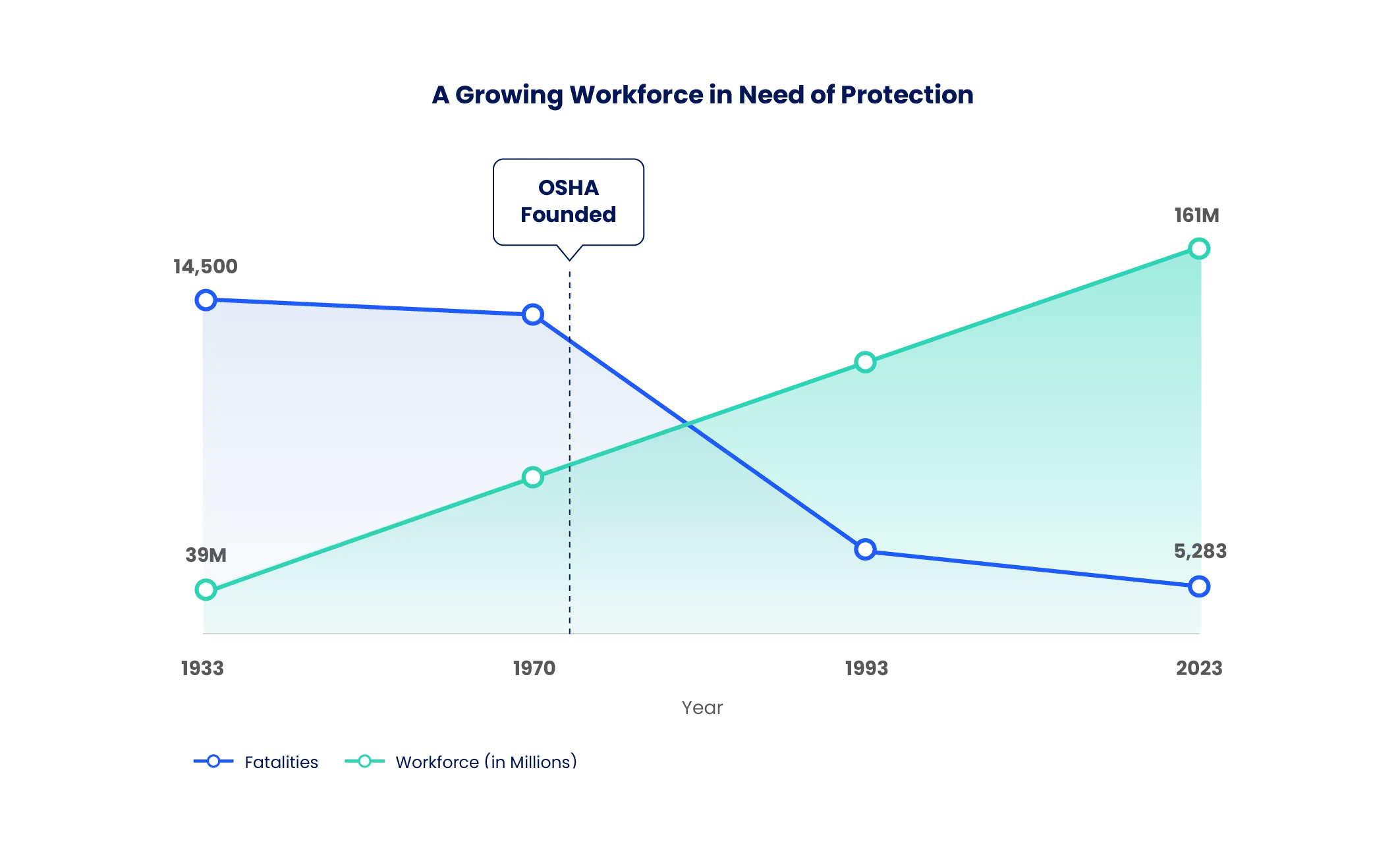
However, gains in workplace safety don’t come solely from checking traditional prequalification and compliance boxes. A recent uptick in U.S. workplace fatalities points to a need for more to be done by organizations to protect their workers.
Our research indicates that there are system drivers beyond prequalification and compliance that contribute to sustained safety performance. These include:
- First-time prequalification
- Granting of variances
- Regular safety manual audits
- Long-term tenure
- Good financial health
Let’s take a dive into these five system drivers by analyzing the data to reveal the correlation between them and workplace safety.
First-time prequalification completion
Prequalification processes assess a supplier’s baseline commitment to safety policies, certifications, and compliance standards. However, repeated resubmissions during prequalification can signal underlying issues.
A salient insight from our customer network data is the difference in safety performance between suppliers who complete prequalification on their first attempt versus those who require resubmissions:
- Suppliers who passed prequalification on their first try had a Total RecordableIncident Rate (TRIR) of 1.25, which was 3% lower than suppliers who had to resubmit
- For Days Away, Restricted, or Transferred (DART) rates, the gap was even wider: 6% improvement for first-time completers
- The Lost Workday Case Rate (LWCR) was 0.77 for first-time completers, compared to just 0.50 for those who resubmitted, indicating a 6% improvement.
Suppliers or contractors who fail to meet first-time submission requirements may exhibit gaps in their understanding of safety standards, misaligned processes, or insufficient safety protocols, increasing the risk of future incidents. First-time completers, meanwhile, achieve a stronger safety performance due to better initial preparedness and alignment with safety expectations.
Granting of variances
Variances are regularly requested and often approved in certain industries such as construction, real estate, manufacturing, and others. Suppliers may require flexibility that causes them to deviate from their original contract. It may involve raw material substitutions, amendments to processes and SOPs, dimensional or quality differences, or other changes.
While it might seem counterintuitive, being granted a variance correlates with significant improvements in safety KPIs.
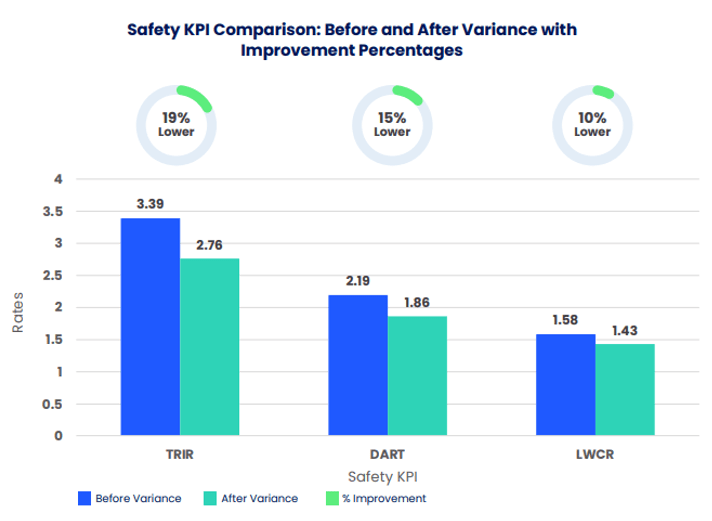
Indeed, our data shows that after a supplier has been granted variances they see marked improvements in all three safety KPIs: TRIR lowered by 19%, DART by 15%, and LWCR by 10%.
This is due to several factors, including increased scrutiny and oversight, thorough evaluation of processes before variances are granted, enhanced collaboration between suppliers and clients, stronger commitment to maintaining variances, and improved reporting practices.
The role of safety manual audits
A safety manual audit is a systematic and thorough review of a company's safety policies, procedures, and practices to ensure alignment with the latest safety guidelines. Auditors perform a comprehensive review of safety manuals and systems in order to identify risks, address gaps and improve safety performance. Failing to regularly conduct a manual audit can lead to outdated practices and even non-compliance.
Our data shows a clear improvement in safety performance for suppliers that regularly conduct manual audits, including a 14% lower TRIR, 11% decrease in DART, and 15% reduction of LWCR. But the story doesn’t end there.
When we extended our data to reflect manual audit tenure, the results showed that Avetta suppliers with more than three years of manual audit experience consistently outperform those with less than three years. Companies experienced a staggering 48% decrease in TRIR, 14% lower DART, and 14% lower LWCR. The most notable improvement for saving worker lives is a 15% reduction in fatalities, which underscores how important manual audits can be to improving overall workplace safety.
The cumulative benefits of tenure
When it comes to workplace safety, there is a strong correlation between longer tenures and safety performance. Recent data reveals a compelling story: suppliers who maintain longer relationships within Avetta’s network consistently show improvements across multiple safety metrics.
Our data shows that TRIR steadily lowers as supplier tenure increases, dropping from 1.38 for suppliers with 2-3 years of experience to 1.18 for those over 10 years — a substantial 14% decrease. DART rates follow a similar trend, declining 16% from 0.83 to 0.7 over the same tenure span.
Even more striking are Lost Workday Case Rates (LWCR), which demonstrate a 22% decrease between short and long-term suppliers, falling from 0.55 to 0.43. These consistent downward trends across all metrics point to the cumulative benefits that drive safety maturity.