


Key Takeaways
- Strategically layering risk management capabilities corresponds to stronger safety and operational performance compared to relying on individual capabilities alone.
- Suppliers using five foundational HSE capabilities report a 97.3% reduction in fatality rates.
- Expanding beyond HSE with ESG, business risk monitoring, and Safety Maturity Index (SMI) improves visibility into broader supply chain risk.
- Connected risk management systems help organizations identify gaps earlier, strengthen supplier alignment, and reduce operational disruption.
- Continuous improvement frameworks like the PDCA help organizations sustain and operationalize safer performance across the supply chain.
Introduction
In our previous blog, we talked about how strong safety foundations and expanded visibility into supply chain risk leads to better safety performance. But improving safety performance requires more than implementing capabilities in isolation. The greatest impact comes when organizations strategically layer those capabilities together.
As supply chains become more complex, organizations need more than standalone safety processes. Risk now spans workforce readiness, operational visibility, supplier governance, and broader business conditions. Without connected oversight across these areas, gaps become harder to identify, making it more difficult to prevent incidents and maintain consistent safety performance across the supply chain.
Data from Avetta’s 2026 Insights & Impact Report shows that organizations demonstrate significantly greater safety and operational improvements when they strategically combine risk management capabilities. Each additional layer enhances visibility, strengthens alignment, and reinforces protection across the supply chain.
The impact is significant. Suppliers deploying five foundational Health, Safety, and Environment (HSE) capabilities together report a 97.3% reduction in fatality rates. When organizations further expand those layers with tools such as ESG and sustainability, business risk monitoring, and Safety Maturity Index (SMI), early trends point toward zero fatalities.
Here’s how strategic risk management turns individual improvements into stronger, more connected safety performance across the supply chain.
What is strategic risk management, and why does it matter?
Strategic risk management is an approach that combines multiple processes, controls, and capabilities to create overlapping safeguards against incidents.
Each capability adds a new layer of visibility and protection. Some capabilities establish the operational foundation for safe work. Others improve visibility into broader supply chain risk, helping organizations identify issues earlier and respond more effectively. Together, these layers create a stronger and more resilient risk management system.
This matters because supply chain risk is no longer isolated. Safety, operational continuity, workforce readiness, ESG performance, and business stability increasingly influence one another. A single control may catch one issue, but a connected system helps organizations identify patterns, close gaps faster, and reduce the likelihood of serious incidents across the supply chain.
How does strategic risk management improve safety and operational performance?
Data from Avetta’s 2026 Insights & Impact Report shows that each additional layer of risk management strengthens safety performance.
Prequalification alone already creates measurable impact by establishing a strong compliance and safety baseline. Suppliers that participate in prequalification report significantly lower severe injury and fatality rates. However, outcomes improve even further as organizations add additional foundational HSE capabilities.
Organizations implementing all five foundational HSE capabilities — prequalification, insurance verification, safety audits, worker management, and worksite scheduling and permissions — report 39.3% lower global severe injury rates (GSIR) and 97.3% lower fatality rates.
Figure 1.0: Fatality rates are 97% lower for suppliers that use five Avetta HSE capabilities
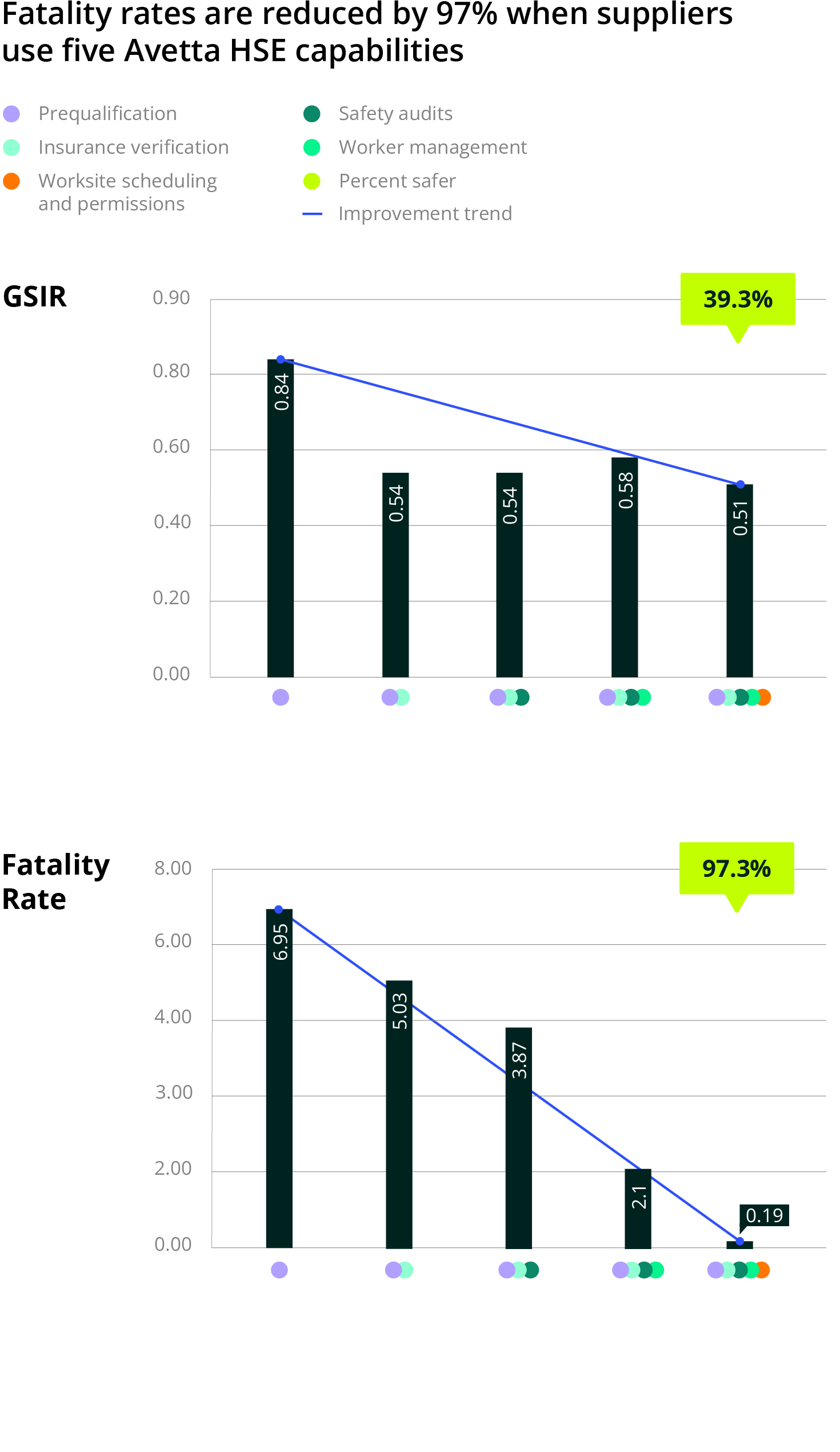
Operational impacts are just as significant. Compared to suppliers that only participate in prequalification, suppliers that engage with all five safety capabilities could experience up to:
- $24,060 less overhead per year
- 130 work hours saved annually
Why does strategic layering work so effectively?
Each capability improves visibility of a different type of risk. As capabilities are added, organizations gain:
- Better visibility into operational and workforce risk
- Earlier identification of gaps and unsafe conditions
- More consistent safety expectations across suppliers
- Stronger communication and alignment between hiring clients and suppliers
- Better coordination between compliance, safety, and operational teams
Strategically layered systems also reduce the disconnection that often contributes to incidents — including outdated procedures, incomplete documentation, workforce qualification gaps, and inconsistent worksite controls.
Most importantly, interlocking capabilities reinforce one another. Worker readiness becomes more effective when connected to worksite controls. Audits are more valuable when paired with stronger supplier visibility. Safety oversight becomes proactive when organizations monitor operational conditions continuously rather than periodically.
What happens when organizations move beyond foundational safety capabilities?
The strongest safety outcomes emerge when organizations expand beyond traditional HSE controls and improve visibility into broader supply chain risk.
The report found that layering foundational HSE capabilities with ESG, business risk monitoring, or SMI capabilities corresponded with zero fatalities among observed supplier cohorts:
- All 5 + ESG: 0.0 fatalities
- All 5 + Business Risk: 0.0 fatalities
- All 5 + SMI: 0.0 fatalities
While these findings are based on early and evolving data, results thus far strongly highlight how many contributing factors to fatal incidents sit outside traditional safety compliance processes.
Operational instability, weak governance, financial stress, and low organizational maturity can all increase supply chain risk — even when baseline compliance requirements are met.
By expanding insight into these broader operational conditions, organizations can identify risk earlier and respond before issues escalate.
Capabilities like ESG, business risk monitoring, and SMI help organizations:
- Identify higher-risk suppliers earlier
- Detect operational instability before it leads to incidents
- Improve oversight of supplier maturity and readiness
- Strengthen consistency across global operations
- Ensure suppliers are not only compliant, but truly ready to work
Success in action: How layered risk management performs in real-world supply chains
One global enterprise commerce company applied this layered approach across a complex contractor ecosystem of more than 15,000 suppliers and 135,000 workers across 25 countries.
To improve supplier governance, workforce readiness, and operational readiness, the organization layered multiple Avetta safety capabilities: prequalification, safety audits, worker management, worksite scheduling and permissions, Safety Maturity Index, and subcontractor management.
By connecting these capabilities across regions, the organization gained a clearer view of supplier readiness, worker compliance, and critical safety gaps. The improved visibility helped teams identify needed actions before issues could affect operations, achieving:
- 100% adoption across most operational regions
- Identification of 2,801 workers not yet ready to work
- Identification of 1,545 suppliers with critical safety gaps
- Product-specific injury rate improvements between 30% and 49%
- 20% global GSIR improvement after layering capabilities together
Figure 2.0: GSIR improved significantly for each supply chain safety solution implemented
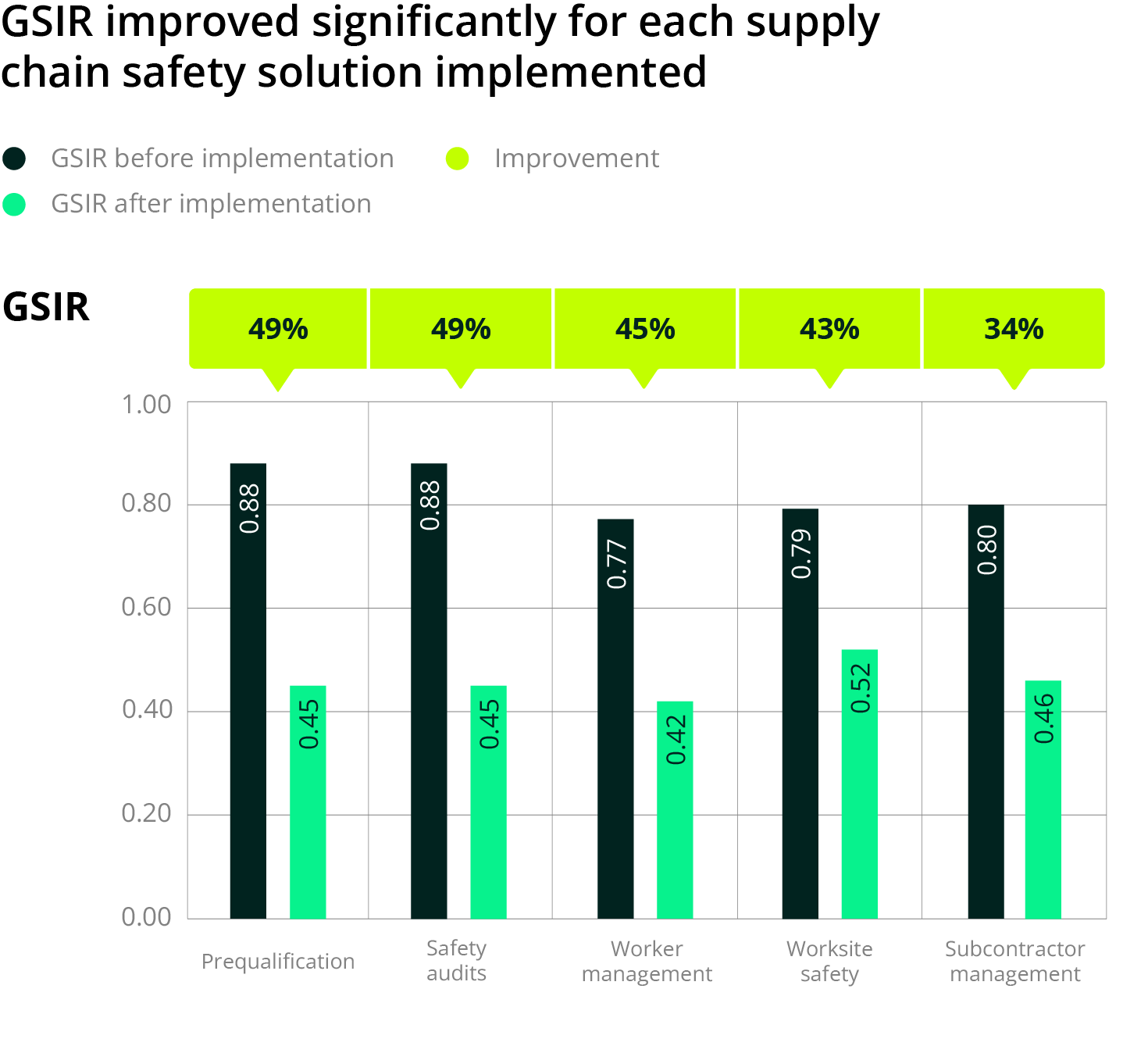
Operational efficiency also improved. The adopted safety capabilities contributed to $8.1 million in annual overhead savings and more than 69,000 work hours saved per year for all the suppliers across the company’s supply chain.
Layered risk management turned a complex supplier network into a more visible, coordinated, and measurable system — one that reduced risk, costs, and enhanced how work was planned, approved, and performed.
How can organizations turn strategically layered risk management into continuous safety improvement?
Risk management capabilities improve safety performance. Strategically layering them creates even greater impact. The next challenge is ensuring those improvements become repeatable, scalable, and sustainable across the organization. Additional capabilities alone will not get organizations there. They need a structured way to connect insights, actions, and improvements over time.
The Plan-Do-Check-Act (PDCA) methodology provides that structure by linking planning, execution, evaluation, and action into the operational cycle.
Capabilities like prequalification, audits, worker readiness, ESG, and business risk monitoring require a unifying structure to operate together, rather than as isolated point solutions. By siting capabilities within a PDCA framework, organizations can continuously evaluate performance, identify emerging risks earlier, and strengthen how safety controls are integrated across the supply chain. Improvement cycles become continuous, and organizations can move beyond reactive compliance to constant operational readiness embedded in routine risk management.
Safer outcomes start with a strategic approach to layered risk management
Across the data, one point stands out: stronger safety performance depends on how well organizations integrate risk management capabilities across their supply chains. When capabilities work cohesively, teams can identify risk earlier, act with greater consistency, and reduce gaps before they lead to incidents.
Foundational HSE capabilities set an effective baseline, and expanded visibility into operational, ESG, and business risk strengthens oversight. But the greatest impact comes when capabilities are strategically layered as part of an interconnected system. Organizations deploying layered risk management capabilities consistently report lower fatality rates, stronger operational performance, and greater readiness across supply chains.
Readiness is not built with isolated controls or one-time compliance activities. It comes from fully integrated systems that monitor diverse risk types to reinforce safer performance across the entire enterprise. When organizations approach risk management strategically, they create supply chains that are safer, stronger, and truly ready to work.
Explore the data behind stronger safety performance
Download Avetta’s Insights & Impact Report 2026 to explore how interconnected risk management capabilities help organizations reduce injuries, strengthen operational resilience, and keep work moving safely and consistently across the supply chain.

