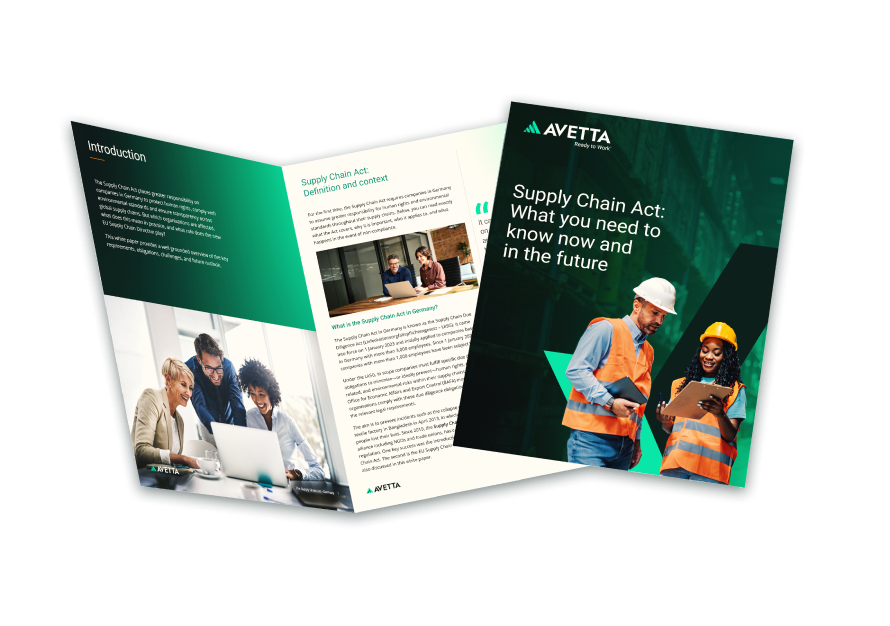
The current state of the German Supply Chain Due Diligence Act (LkSG) reflects a wider shift across Europe, one that balances reducing bureaucracy with maintaining competitiveness and protecting people and the environment.
For businesses, this creates a clear challenge: how do you stay compliant while keeping operations moving forward with confidence?
The answer lies in readiness. Because in a landscape defined by change, compliance alone isn’t enough. Your supply chains need to be prepared to adapt, respond, and perform.
What is the supply chain due diligence act?
Since 1 January 2023, the Supply Chain Due Diligence Act (LkSG) has required certain companies in Germany to uphold human rights and environmental standards across their supply chains.
These include protection against child labour, forced labour and discrimination, and compliance with occupational health and safety and environmental standards. Companies must also analyse risks in their supply chain, implement targeted prevention measures if necessary, and apply appropriate remedial measures in the event of violations.
In practice, this means building structured approaches to risk by identifying issues early, taking preventive action, and ensuring accountability across both direct and indirect suppliers.
The goal is not just compliance, but more resilient, transparent, and responsible supply chains.
Who does the supply chain due diligence act apply to?
The law currently applies to companies with at least 1,000 employees, previously this was 3,000. that have a registered office or branch in Germany.
Even if your organisation falls outside this scope, you may still be affected. Small and medium-sized enterprises that don’t meet the conditions may still be indirectly affected by the Supply Chain Due Diligence Act (LkSG) – especially when working as suppliers to companies that must comply. This results in increased compliance requirements on the part of buyers, increased reviews and audits, and increased expectations in terms of data and documentation.
This is where readiness becomes shared. If one part of the supply chain is under pressure, it affects everyone.
Where does the supply chain act currently stand in Germany?
Recent discussions around reform, including efforts to reduce reporting requirements and administrative burden, highlight just how dynamic the regulatory landscape has become.
On 11 June 2021, the Bundestag adopted the draft law on corporate due diligence obligations in supply chains to better protect human rights and the environment in the global economy. 412 MPs voted in favour, 159 against, and 59 abstained.
Even then, there were opposing voices. The AfD parliamentary group has tabled two motions to abolish or weaken the Supply Chain Act. The motion of the Left Party, on the other hand, was aimed at improvement. Both applications were rejected. But beyond the debate, one thing is clear: supply chain legislation in Germany is evolving, not disappearing.
For businesses, that means preparing not just for today’s requirements, but for what comes next.
The supply chain act as a political issue in Germany
Experts continue to emphasise that the Supply Chain Due Diligence Act (LkSG) can deliver meaningful impact, but only when implemented consistently and supported by clear frameworks.
Annabell Brüggemann, Senior Legal Advisor at the European Center for Constitutional and Human Rights (ECCHR) and author of an LkSG study conducted by ECCHR together with Bread for the World and Misereor stated in May 2025 that the Supply Chain Act is having an effect as things stand, "but only if it is consistently enforced".
At the same time, current discussions point to ongoing pressure to simplify regulation and reduce complexity for businesses.
This tension reflects a broader reality: companies are being asked to balance compliance, competitiveness, and responsibility, all at once.
Chronology: How the LkSG has evolved
Understanding how the Supply Chain Due Diligence Act (LkSG) has developed helps businesses move beyond reacting to regulation, and toward building supply chains that are ready for ongoing change.
- 2016: The German government adopts the National Action Plan for Business and Human Rights, according to which companies should voluntarily comply with human rights due diligence obligations. It turns out that the implementation is not enough.
- 2019 to 2020: Because the voluntary measures are not taking effect properly, a political debate arises. Many are calling for a binding law. The Federal Ministry of Labour and Social Affairs and the Federal Ministry for Economic Cooperation and Development in particular are in favour of such plans.
- 2021: The Bundestag passes the LkSG, which for the first time legally obliges large companies to exercise due diligence in their supply chains. At the end of November, the SPD, Greens and FDP also committed themselves to an EU supply chain law.
- 2023: In the first stage, the German Supply Chain Act applies to companies with at least 3,000 employees. In the summer, the EU Parliament will also vote in favour of a European supply chain directive.
- 2024: The scope of application of the LkSG is extended to companies with at least 1,000 employees. On July 25, the CSDDD will come into force.
- 2025: The German government wants to reform the current status of the German Supply Chain Act. The aim is to reduce the bureaucratic burden and to bring the LkSG closer to the EU rules. In November, the EU Parliament votes to relax the EU-wide law.
Today, both German and EU frameworks remain in flux, reinforcing the need for adaptable, forward-looking approaches.
The supply chain act in the current coalition agreement
The coalition agreement between the Union and SPD has outlined plans to replace the current Supply Chain Due Diligence Act (LkSG) with a revised framework focused on reducing bureaucracy and improving enforcement efficiency.
However, the specifics remain unclear, and timelines extend into the late 2020s.
The development, however, does show that sustainable and responsible supply chains continue to play a central role. For businesses, this uncertainty reinforces a key point: waiting for clarity isn’t a strategy. Building readiness is.
EU supply chain act: Current status
At EU level, member states must transpose the European Supply Chain Directive into national law.
The start of application was initially on 26 July 2027, however recent adjustments, including delayed timelines and higher thresholds, reflect an effort to balance ambition with practicality.
Even so, the overall direction is unchanged: supply chain transparency, accountability, and resilience will remain central expectations across Europe.
How the omnibus package changed the Corporate Sustainability Due Diligence Directive
The term "omnibus" refers to a proposed law that adapts several existing laws at the same time. The Omnibus I package, adopted in December 2025, significantly reshaped the scope of the European Corporate Sustainability Due Diligence Directive (CSDDD), increasing thresholds so fewer companies fall directly within scope. Originally, the regulations applied to companies with 1,000 employees and an annual net turnover of over 450 million euros. After the reform, the scope of the CSDDD only covers very large companies with more than 5,000 employees and a turnover of over 1.5 billion euros.
At the same time, certain requirements, including aspects of climate transition planning, have been scaled back.
What does this mean in practice? While this reduces immediate pressure for some organisations, it also creates variation across markets, making consistency harder to achieve.
How does the EU directive affect the German supply chain act?
The CSDDD will ultimately shape national legislation in Germany and across Europe. The aim is a European-harmonised system with a uniform legal framework. The only question is: What will it look like? Since the decision at EU level, there has been a lot of dispute about the content.
For businesses operating internationally, this creates both complexity and opportunity.
Because while regulations may differ in detail, the underlying expectations remain aligned:
- Visibility across supply chains
- Accountability for risk and performance
- Strong, transparent supplier relationships
How Avetta helps companies meet supply chain due diligence
Despite ongoing discussions, the core objective remains unchanged: Protecting people, strengthening supply chains, and enabling responsible global business.
What is less certain is how the final regulatory framework will take shape. But one thing is clear, supply chain legislation in Europe is here to stay.
For your organisation, that means shifting from reactive compliance to proactive readiness. Because when requirements evolve, the organisations that succeed are those already prepared, with the right insights, systems, and partners in place.
We help organisations connect risk, compliance, and performance in one place, so your teams stay aligned and ready to work.
With Avetta, you can:
- Strengthen supplier due diligence
Centralise supplier prequalification and ensure they meet required safety, sustainability, and compliance standards before they start work. - Improve supply chain visibility
Get a clearer, real time view of supplier performance and risk at all levels of the supply chain to make more informed decisions. - Streamline compliance processes
Reduce your administrative overheads with automated workflows, standardised data collection, and simplified reporting that align with changing regulatory requirements. - Risk mitigation and business continuity protection
Identify and remediate potential human rights, environmental and operational risks early on, reducing the likelihood of business interruptions, penalties or reputational damage. - Scale securely across global business units
Apply consistent standards across all regions and help your supply chain partners comply with both national laws such as the LkSG and broader frameworks such as the CSDDD.
Because readiness isn’t just about meeting today’s standards, it’s about being equipped to meet what comes next.
Ready to strengthen your supply chain readiness? Connect with Avetta to see how your teams can move forward with confidence.