Introduction: Understanding the Five Levels of Safety Maturity
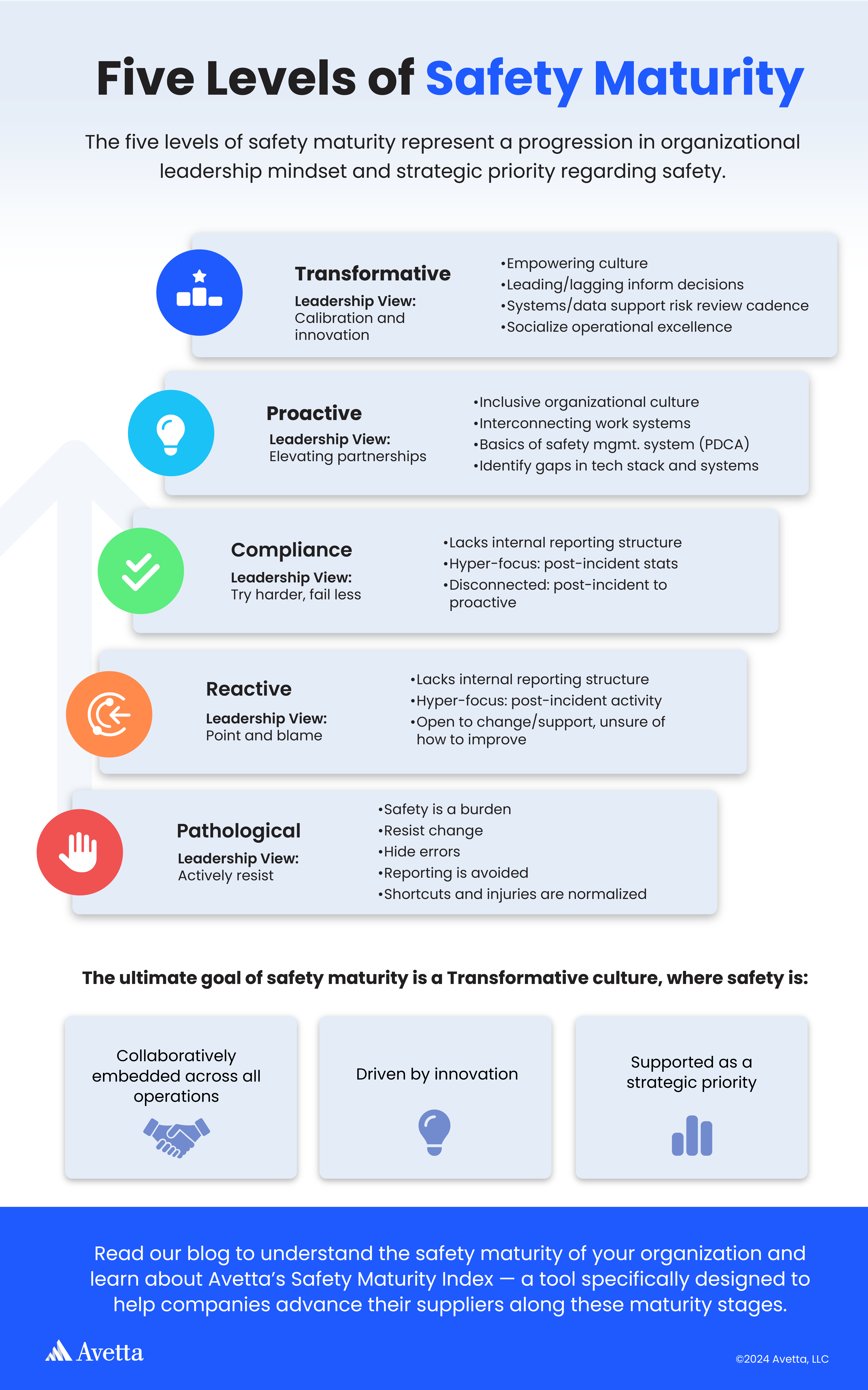
In our previous post, we explored the historical eras of safety, illustrating how safety practices have evolved from reactive to proactive, evidence-driven approaches. Now, we turn to the specific levels of safety maturity — Pathological, Reactive, Compliance, Proactive, and Transformative — which represent an organization’s mindset and approach to safety.
Each maturity level reflects how leadership perceives safety. Organizations at the Pathological level often resist safety measures, while those at the Transformative level fully integrate safety into every part of their operations. While compliance sets a baseline, simply meeting regulatory standards doesn’t always ensure a safe environment. To build a stronger safety culture, organizations must go beyond compliance — embracing proactive strategies that actually lower risks.
In this blog, we’ll examine each level’s distinct characteristics and leadership mindsets. As you read, consider where your organization currently stands and the steps needed to progress toward a Transformative safety culture, where safety is embedded as a core value.
Level 1: Pathological (Actively Resist)
At the Pathological level, safety is seen as a burden — something to resist, ignore, or hide. Concerns are dismissed or concealed, with little interest in improving worker protection. Leaders at this level focus on avoiding penalties rather than managing real risks.
This pathological safety culture of active resistance lacks accountability. Incidents may be covered up or go unreported, creating mistrust and low morale. Safety is viewed as an obstacle, not a driver of performance — leaving the organization exposed to accidents, regulatory action, and high turnover.
Progressing beyond this level of safety maturity requires a mindset shift: recognizing safety as a core responsibility critical to long-term business success.
Level 2: Reactive (Point and Blame)
At the Reactive level of safety maturity, organizations acknowledge the need for safety but lack a clear strategy. Efforts are mostly reactive — addressing problems as they arise rather than proactively preventing them or learning from them. Leaders at this level often resort to “point and blame” tactics when dealing with injuries, equipment failures, or spills, with little focus on long-term solutions.
Organizations at this stage may have experienced rapid growth or changes that outpace their ability to manage safety effectively. Additionally, they often lack the resources or knowledge to build strong systems and tend to see safety failures as worker errors, not leadership or process issues.
Short-term fixes dominate at this stage. Progress requires building foundational safety practices, meeting basic compliance requirements for health and safety management, and shifting toward a more systematic, risk-aware approach.
Level 3: Compliance (Try Harder, Fail Less!)
At the Compliance level, organizations meet basic regulatory standards but lack a broader safety vision. Safety is seen as a box to check — driven by legal obligations rather than performance goals. Leaders often take a “Try harder, fail less!” mindset, focusing on post-incident metrics and avoiding penalties rather than improving outcomes.
Foundational practices like worker training, incident tracking, and injury and illness reporting are in place, but efforts rarely go beyond the minimum. Organizations at this stage see safety as a rulebook, collecting lagging indicator metrics that inform the organization of what happened retroactively while lacking any prescriptive, specific methods to improve.
To advance, organizations must shift from compliance for its own sake to safety as a strategic priority. This means leveraging both lagging and leading indicators and embedding safety into everyday operations.
Level 4: Proactive (Elevating Partnerships)
At the Proactive level of safety maturity, organizations move beyond compliance to actively prevent incidents. Leaders at this stage deeply understand their operations, using both lagging and leading indicators, along with workforce feedback, to monitor risks and drive improvement. Safety becomes about anticipating errors and strengthening controls, not just meeting standards.
This level reflects a shift toward continuous improvement and shared responsibility. Workers — including contractors, subcontractors, and temporary workers — are seen as key partners in safety, not problems to manage. Raising expectations for third-party safety practices becomes essential.
Leaders at the Proactive level foster collaboration through established Safety Management Systems such as the Plan-Do-Check-Act (PDCA) model, which encourages workers to report risks and suggest improvements. This inclusive approach strengthens safety culture in joint-employer environments through active “Leader/Worker Participation.”
Advancing from here means fully integrating safety into all aspects of the organization, including evaluating the technology stack and systems used for gaps, setting the groundwork for a truly Transformative safety culture.
Level 5: Transformative (Collaboration and Innovation)
At the Transformative level, safety is deeply embedded in the organization’s culture and strategy. It’s not a separate function, but an integral part of daily operations. Leaders at this stage champion safety through active worker feedback, continuous improvement, and strong organizational support at every level.
Transformative organizations rely on “clean safety data” from both leading and lagging indicators to guide decisions. They build partnerships with contractors, suppliers, and communities to promote collective safety and ensure contractor compliance. Cross-functional collaboration is central, with departments like procurement, operations, and HR aligned around safety goals and shared strategies.
At this highest level, safety becomes a source of pride, where every employee understands and contributes to safety goals. The Transformative level represents the pinnacle of safety maturity, where continuous learning, adaptability, and proactive planning define the culture, creating a resilient organization capable of facing evolving safety challenges.
Conclusion: Advancing Toward a Transformative Safety Culture
Understanding the five levels of safety maturity offers a useful framework for evaluating your organization’s approach to safety while aligning safety practice and innovation toward well-established safety management systems, such as ANSI Z-10, ANSI Z-16, or ISO 45001. Progressing through these stages allows companies to move beyond basic compliance management and create a resilient, proactive safety culture. At the highest level, safety becomes embedded in every aspect of the business, fostering an environment where continuous improvement, collaboration, and innovation drive safety outcomes.
Knowing where your organization or supply chain stands, however, is only the beginning. In our next blog, we’ll introduce Avetta’s Safety Maturity Index — a tool specifically designed to help companies advance their suppliers along these maturity stages. Using leading indicators to identify gaps in safety practices, the index pinpoints areas where improvement is needed to reduce the occurrence of serious injuries and fatalities (SIFs). This maturity index offers a strategic approach to elevating your supply chain’s safety maturity, providing actionable insights that make transformative safety attainable.
Download Avetta’s Safety Maturity Index White Paper
If you would like to learn more about safety maturity and how your organization can evolve toward a truly transformative safety culture, download our latest white paper, Understanding the Role of Safety Maturity in Today’s Supply Chain: Introducing Avetta’s Safety Maturity Index.
Avetta is a SaaS software company providing supply chain risk management solutions. Avetta’s contractor management platform is trusted by over 130,000 suppliers in over 120 countries. Visit Avetta.com to learn about how our new Safety Maturity Index can help you go beyond compliance and prequalification.